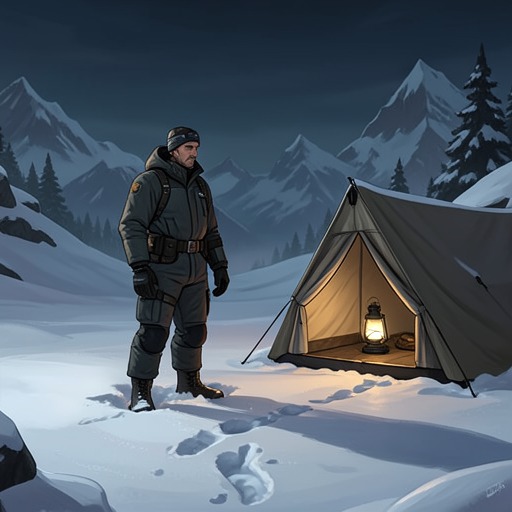
Mowat tracks wolf prints and finds the den
Never Cry WolfFarley Mowat tracks wolf prints and finds the den in a sequence that changes his investigation from an abstract search into a chance to observe a wolf family at close range. He first sets out to follow a wolf whose trail leads across the open muskeg, but a missing compass sends him back to the cabin. On a later attempt, he loses the trail, pauses beside a lake, and notices what proves to be two wolves on a sand esker. Their play and the female’s disappearance into a shadow in the slope reveal the den; the male’s vigilance then turns discovery into a test of how carefully the observer can approach.
The First Trail and the Missing Compass
After an encounter the previous evening, Farley Mowat reconsidered his hasty withdrawal and resolved to try to regain contact with the wolf. His plan was direct: return to the place where it had disappeared, find its tracks, and follow them. He packed food, checked his rifle and revolver ammunition, took binoculars, and set off across difficult, rocky ground.
The first tracks appeared in a stretch of chocolate-colored bog beyond a low crest. Their scale unsettled him. He had read that an arctic wolf’s prints could measure six inches across, but seeing them laid out in the muskeg made the measurement immediate: the broad prints and a stride of about forty inches suggested an animal of formidable size. The physical evidence of the wolf altered the character of the pursuit before he had found the wolf itself.
Mowat then discovered that he had left his pocket compass behind. He judged it unsafe to continue into unmarked wilderness without it and returned to the cabin. The interruption was not simply a delay: it exposed the distance between planning a field study and moving through a landscape where navigation could not be treated as a minor detail. Back at the cabin, he could not remember where he had put the compass, and consulting a standard reference on wolves only sharpened the contrast between textbook description and the tracks he had just seen.
The compass turned up the next morning while he was cleaning the cabin. Its brass surface caught the sunlight on the windowsill, prompting him to try again. This time the excursion was more heavily equipped: alongside the rifle, he carried a shotgun, pistol, pistol belt, hatchet, hunting knife, binoculars, and a flask of wolf-juice. The load slowed him, and the hot subarctic day brought the first mosquitoes, an early sign of the swarms that would make travel increasingly difficult.
Across the Muskeg to the Esker
Mowat relocated the tracks and followed them for several miles over the muskeg. The difference between wolf and human movement became measurable in the ground itself: the wolf had sunk only three or four inches, while Mowat’s steps sank until they reached solid ice about a foot below the surface. When the tracks disappeared beyond a gravel ridge, his attempts to pick them up again were perfunctory. The immense, empty landscape and lack of familiar sounds left him feeling exceptionally isolated.
From a niche among lichen-covered rocks, Mowat ate and drank before using his binoculars to search for life. Across the ice-covered bay of a great lake, a yellow sand esker rose above the flat surroundings and wound away into the distance. These ridges were the deposited beds of rivers that had once flowed through glaciers covering the Keewatin Barrens. In a landscape with little visual relief, the esker provided both a conspicuous landmark and, as Mowat soon discovered, a place where the wolves could move out of sight.
At first he glimpsed what seemed to be a person waving an arm beyond the ridge. As he moved along the shore for a better view, the object appeared like a white plume being waved by someone hidden from sight. A second appeared, and the two shapes moved parallel to the esker’s crest. The apparent mystery resolved when the shapes turned toward him and rose above the ridge: they were the tails of two wolves walking along its upper edge. The episode made the distance and limits of observation plain. From far away, movement could be visible before its source was identifiable.
The Wolves at Play and the Den
The esker overlooked Mowat’s position on the shore. He crouched among the rocks, but the wolves appeared absorbed in their own activity. The smaller wolf, later identified as female, initiated a game of pursuit with the much larger male—the same wolf Mowat had encountered two days earlier. She lowered her front end, raised her hindquarters, and sprang toward him. When he stumbled in trying to avoid her, she chased him; then he pursued her in turn. They ran over and down the esker until both lost their footing on a steep slope and slid down together.
At the bottom they separated, shook sand from their coats, and stood panting. The female then climbed against the male and showed him prolonged affection. Mowat watched a pattern of playful, intimate behavior that sharply differed from the threatening image suggested by the wolf’s tracks and his own earlier apprehension. The scene did not make the male harmless: it showed that his behavior depended on circumstances, and that the observer was seeing a social animal rather than only the powerful creature he had imagined from its footprints.
The female then climbed partway up the esker and vanished. Mowat eventually located the dark opening of a den in a fold of the slope and understood that she had gone inside. Elated at finding both a pair of wolves and what appeared to be their den, he ran to a nearby rise for a better view. That unplanned approach changed the scene. The male spotted him, bounded to the crest, and watched him with tense vigilance. The playful animal of a moment earlier now appeared alert to an intrusion near the den.
Mowat decided not to press closer. He feared that disturbing the family might force it to move, jeopardizing the opportunity for continued observation. He withdrew backward over broken rocky ground while carrying his scientific equipment. From farther away he saw that the female remained out of sight and that the male had relaxed enough to lie down on the crest and settle for a nap. His retreat thus ended without a chase or an attack, but with a practical limit established: locating a den did not grant him permission to disregard the wolves’ response to his presence.
From Discovery to Observation
The next morning Mowat returned with a high-powered periscopic telescope and tripod instead of some of the equipment he had carried on the previous excursion. He selected a rocky knoll about four hundred yards from the den, positioning the instrument to look over its crest while keeping himself hidden. He also approached so the wolves could not see him and the wind carried his scent away from them. The contrast with the previous day’s unplanned run toward the den marks a change in method: observation now depended on distance, concealment, and care not to provoke the animals.
The concealed position produced no immediate sighting. Although the telescope could resolve the sand grains on the esker, Mowat found no sign of wolves across the area he searched for miles on either side of the den. By noon, eyestrain and cramps had made the long vigil physically uncomfortable, and he was beginning to doubt whether the place was a den at all. The encounter had yielded a compelling discovery, but it had not ensured that the wolves would appear on a human schedule.
In retrospect, the first visit established the central tension of Mowat’s fieldwork: the den offered a rare opportunity to observe wolf life, while the wolves’ freedom to leave, hide, or respond to disturbance set the terms of access. Later observations identified the male and female as George and Angeline and established that a third adult, Uncle Albert, was also associated with the family. Those later findings give the initial sighting its place in a longer study, but the discovery itself remains tentative in form: tracks lead to a meeting, the meeting reveals a den, and the den’s occupants determine how much the observer can learn.